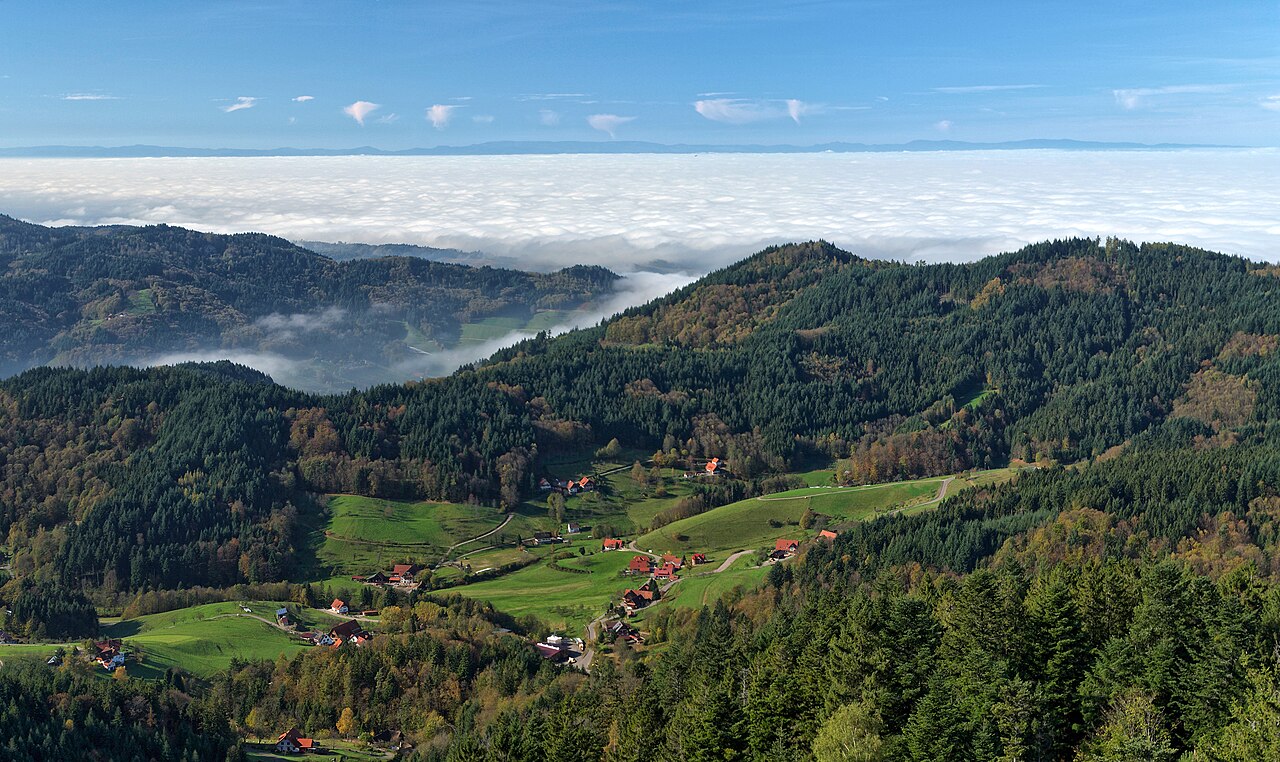
Black Forest: how Germany's southwestern mountain range became a tourism heartland
The Black Forest is in the news after the Ghana News Agency reported the opening of the Christmas market in its Ravenna Gorge, an event that
Black Forest: how Germany's southwestern moun
The Black Forest is in the news after the Ghana News Agency reported the opening of the Christmas market in its Ravenna Gorge, an event that has drawn a growing international following through social media.
The Black Forest, known in German as the Schwarzwald, is a large wooded mountain range in Baden-Württemberg, in Germany's southwest. The Rhine Valley borders it on the western and southern sides, and France and Switzerland lie close by. Two major rivers, the Danube and the Neckar, both rise within it.
The range is roughly oblong. It runs about 160 kilometres from end to end, is up to 50 kilometres wide and covers around 6,009 square kilometres. Its summit is the Feldberg, which reaches 1,493 metres above sea level.
For much of its history the local economy depended on timber and on mining its ore deposits. Today tourism has taken over as the leading industry and supports roughly 300,000 jobs, which helps explain why attractions such as a seasonal market in a gorge can draw large crowds.
The area has carried several names. In antiquity it was called Abnoba mons, after the Celtic goddess Abnoba, while in late Roman times it became Silva Marciana, a name drawn from a Germanic word meaning border. It probably formed the frontier zone of the Marcomanni, a people belonging to the Suebi, whose name lives on in the historic region of Swabia. The Romans left a mark mainly around the edges, with baths at Badenweiler, mines near Badenweiler and Sulzburg and the Kinzigtalstraße road. The real settlers were the Alemanni, who moved first into the valleys and then gradually into higher ground. Rötenbach, one of these early villages, appears in records from 819.
The forest also has a turbulent past. Several revolts that came before the German Peasants' War of the 16th century, the Bundschuh movement among them, began there, and the saltpetre uprisings unsettled the Hotzenwald for two further centuries. Ruined fortifications from the 17th and 18th centuries still stand, especially on mountain passes, including baroque earthworks built for Margrave Louis William of Baden-Baden and the Alexanderschanze redoubt.
RelatedRavenna Gorge Christmas market opens in Germany's Black Forest
Source: Ghana News Agency
Background: Wikipedia: Black Forest
Photo: Wikimedia Commons